

From a good governance Index to a personal Honesty Index
In 2016 I had the chance to be a US State Department fellow, and for a few months I lived and worked in Washington DC for a large NGO doing mostly research around good governance and democracy. And, of course, because I was just at the right time in the right location, I could witness first-hand how democracy in America transformed itself – before, during and in the days after the big 2016 elections.
The experience of working for a good governance index (the “Africa Integrity Indicators”) was so profound that it gave me a new perspective on my life, that I’d like to share here.
This research focused on governance in-practice, examining how policies are implemented in all African countries. That research methodology was based on 3 questions:
1. What is the legislation in place (de jure)?
2. What does it look like in practice (de facto)?
3. What is the difference between the two?
When I read the local researchers’ input, it made me think: are there conscious or unconscious differences between what I preach and what I do as well? This new insight stayed with me even before I started discovering and understanding myself through the psychotherapeutic process. Here is how I translated these questions at an invididual level:
1. What is the set of rules that I live by (de jure)? How do I see the world, how do I see myself in it, and what is “the conscious algorithm” that drives my thoughts and actions?
2. What does it look like in practice (de facto)? Do I believe I think and do something in one way, but the facts show otherwise?
3. What is the difference between the two and how does it translate to my wellbeing (and the wellbeing of those around me)?
The other day I read an article (link here) by a fellow psychotherapist. She wrote with so much talent about the lies that we live with and that we truly believe. She gave the example of a client constantly verbalising the need to be near people, while unconsciously doing every action she could just to be alone (link to that article in comments). Somewhere, in her algorithm, closeness was too dangerous to put in practice her de jure.
And so here is my proposal:
There are several good governance, democracy, human rights indexes and their methodologies are looking at whole societies. But at an individual level maybe we need a personal honesty index as well. Do I do what I preach? Do I preach what I do? Ok, not an official index, it’s more methaphoric than that, but wouldn’t it be great to be able to say “Well, maybe I am lying to myself here and there. To be more authentic, as a baby. Or as a cat.

A very useful instrument in coaching is the Johari window. It is not a validated psychological instrument as those I use in my work as a clinical psychologist, but it is the closest instrument that can help answer those questions. Here is my adaptation using the lens of de jure and de facto:
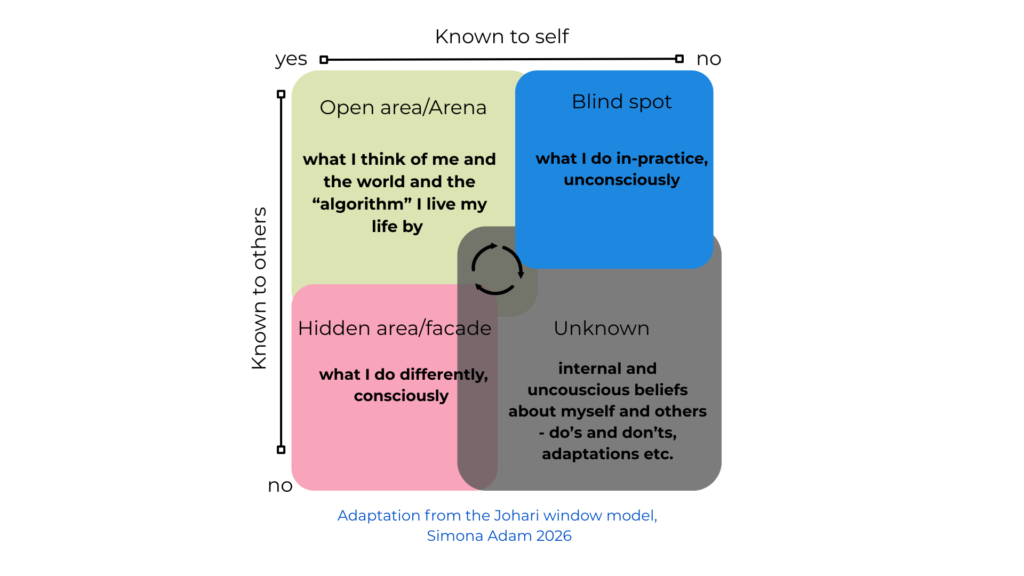
The Johari window, designed over 70 years ago, remains an useful tool in coaching. Its four quadrants were drawn to summarize types of information and relationships:
- Open Area/ Arena is about public behaviors, abilities, bits of own personality known to ourself and to others. What we think about ourselves and others and we can share publicly.
- Blind Spot is about what we do unconsciously, something that others can observe and we don’t.
- Hidden Area/Façade refers to information that we know about ourselves, but we choose to keep it from others. We all have our little secrets, don’t we? 🙂
- In the johari’s window, the Unknown Area refers to abilities, motives, traits that are unknown to us and to others. So much of a long term psychotherapeutic process deals with uncovering this area. In Transactional Analyis we refer to our life scenario, life positions, drivers, injunctions, ego states and many more concepts that I love. In Schema therapy it’s schemas, in other types of therapy there are other concepts that, more or less, encapsulates the same aspects.
The trick with such a personal honesty index is that we need others to do it, just like in other aspects of life. While in relationship with others we can reveal the arena and the façade and maybe uncover bits of blind spots, I think a therapeutic process can reveal so much of all areas, including the big unknown. This is why I love being a psychotherapist so much.
